
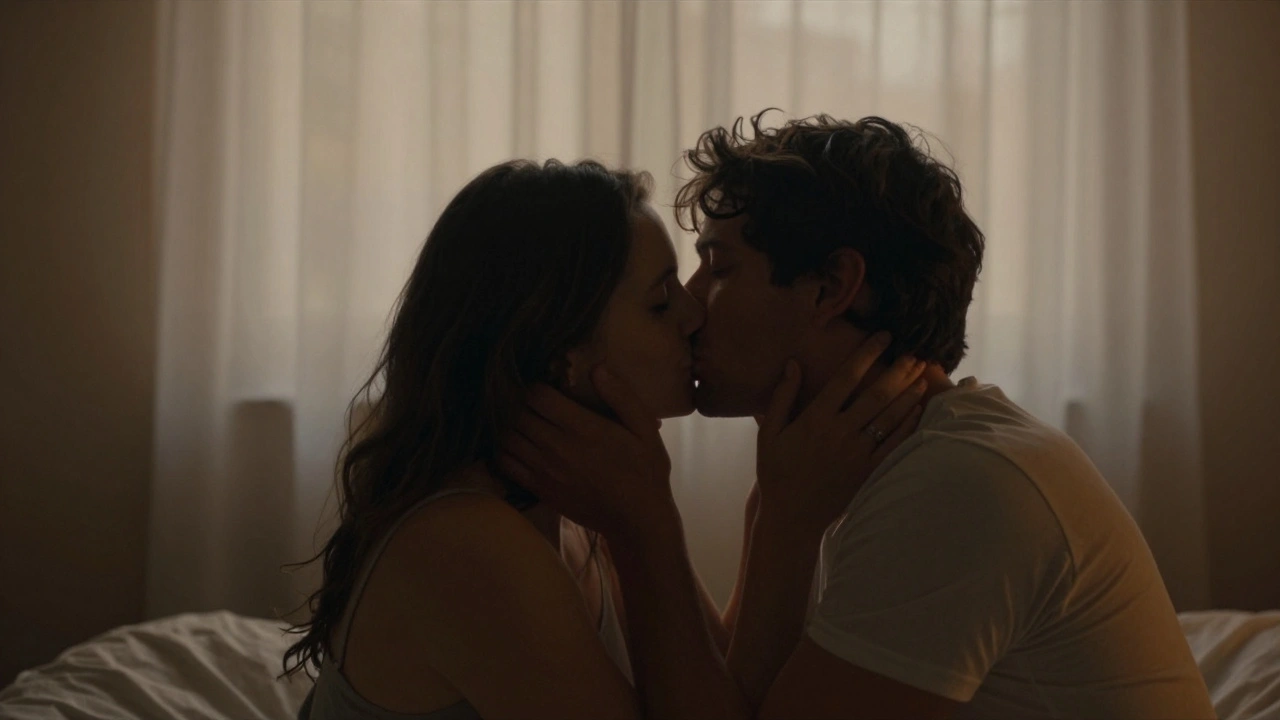
You’ve felt it before-that moment when lips meet, tongues glide softly, and the world outside just fades away. Not because it’s about sex, but because it’s about french kissing. It’s not just a physical act. In quiet moments between partners, it becomes a silent conversation, a way to say I’m here with you without saying a word.
What French Kissing Really Does to Your Brain
When you french kiss, your body doesn’t just react-it rewires. A 2015 study from the University of Oxford found that couples who kissed regularly had higher levels of oxytocin, the hormone tied to bonding and trust. This isn’t just a romantic myth. Oxytocin lowers cortisol, the stress hormone, and makes you feel safe. That’s why after a long day, a deep kiss can feel like coming home.
It’s not just about chemistry. French kissing activates the brain’s reward system-same areas lit up by chocolate, money, or even drugs like cocaine. But here’s the twist: it’s the mutual part that matters. When both people are fully engaged, it creates a feedback loop of closeness. One person leans in, the other responds, and suddenly you’re not just kissing-you’re syncing.
Why It’s Different From a Simple Kiss
A peck on the cheek? That’s polite. A quick lip touch? That’s hello. But french kissing? That’s intimacy with depth. It involves touch, breath, rhythm, and vulnerability. You’re letting someone in-literally. Your mouth is one of the most sensitive parts of your body, packed with nerve endings. When you open up to someone there, you’re giving them access to a part of you that’s rarely shared.
Think of it like this: holding hands says I’m with you. French kissing says I trust you with my most private self. It’s not about performance. It’s about presence. The best french kisses aren’t the most aggressive or skilled-they’re the ones where both people are fully there, breathing together, moving as one.
The Emotional Impact: More Than Just Physical
Relationships don’t die from arguments. They die from silence. From the slow fade of touch. From the days when a kiss becomes a formality instead of a connection.
French kissing rebuilds that bridge. A 2020 survey by the Journal of Sexual Medicine found that couples who kissed deeply at least three times a week reported 23% higher relationship satisfaction than those who didn’t. Why? Because it interrupts the autopilot mode that many long-term relationships slip into. It reminds you: You’re still desirable. You’re still wanted.
It’s also a non-verbal apology. After a fight, a slow, tender kiss can say more than hours of talking. No words needed. Just presence. Just connection.

How to Make French Kissing More Meaningful
It’s not about technique-it’s about intention. Here’s how to turn a simple kiss into something deeper:
- Start slow. Don’t rush. Let your lips linger. Let your breath sync.
- Look into each other’s eyes before you begin. That eye contact sets the tone.
- Focus on touch. Run your fingers through their hair. Rest your hand on their neck. Skin-to-skin contact boosts oxytocin even more.
- Pause. Break the kiss. Look at them. Smile. Then go back in. Those pauses make it feel alive, not mechanical.
- Don’t aim for perfection. The best moments are messy. A tongue that’s too eager, a lip caught, a giggle mid-kiss-those are the memories you keep.
It’s not about who’s better at it. It’s about who’s willing to be vulnerable together.
When French Kissing Feels Awkward
Let’s be real-sometimes it doesn’t feel magical. Sometimes it feels forced. Maybe you’re tired. Maybe you’re stressed. Maybe you’re not in the mood. That’s okay.
Don’t force it. If it feels like a chore, it won’t build intimacy-it’ll drain it. Instead, try this: say, “I really miss kissing you like this. Can we just take five minutes?” That’s all it takes. No pressure. Just an invitation.
And if you’re new to it? Start small. Practice with someone you trust. Learn what feels good. There’s no right way. Only your way.
French Kissing vs. Other Forms of Physical Connection
Not all touch is the same. Here’s how french kissing stacks up against other intimate acts:
| Act | Emotional Depth | Physical Intensity | Requires Vulnerability | Builds Long-Term Bond |
|---|---|---|---|---|
| French Kissing | High | Moderate | Very High | Yes |
| Holding Hands | Moderate | Low | Low | Moderate |
| Hugging | High | Moderate | Medium | Yes |
| Sexual Intercourse | Variable | High | High | Only if emotionally connected |
| Light Touch on Arm | Low | Low | Low | No |
Notice something? French kissing sits in the sweet spot. It’s not as intense as sex, but it’s deeper than a hug. It doesn’t require nudity or performance. Just presence. That’s why it’s so powerful.
Why This Matters in Today’s Relationships
We live in a world where connection is easy to fake. Texts. Likes. DMs. But real intimacy? That’s rare. French kissing doesn’t need Wi-Fi. It doesn’t need a date night. It just needs two people willing to be still, close, and open.
It’s a quiet rebellion against the noise. A way to say: I choose you, right now, in this moment, with no distractions.
And that’s why it matters more now than ever.
Frequently Asked Questions
Is french kissing necessary for a healthy relationship?
No, it’s not required-but it’s one of the most effective ways to build emotional closeness. Some couples bond through touch, conversation, or shared activities. But if you’re not kissing deeply at all, you might be missing out on a powerful tool for connection. It’s not about obligation-it’s about opportunity.
Can you build intimacy with french kissing if you’re not sexually attracted to your partner?
Possibly-but it’s unlikely to work alone. Emotional intimacy thrives on mutual attraction, whether it’s physical, intellectual, or emotional. If you’re kissing to force a feeling that isn’t there, it can backfire. But if you’re curious, try it without pressure. Sometimes, physical closeness can spark emotional warmth-even if it starts small.
How often should couples french kiss to strengthen their bond?
There’s no magic number, but research suggests three times a week makes a noticeable difference. The key isn’t frequency-it’s quality. One deep, mindful kiss can do more than five rushed ones. Aim for moments where you’re both fully present. Even five minutes a day, spread out, can rebuild connection over time.
Why does french kissing sometimes feel awkward or uncomfortable?
It’s normal, especially if you’re out of practice or stressed. Your body might tense up, or you might overthink your technique. That’s okay. It’s not about being perfect. Try slowing down, breathing together, and focusing on how it feels-not how it looks. If it still feels off, talk about it. Sometimes, the discomfort isn’t about kissing-it’s about something deeper in the relationship.
Can french kissing help reignite a fading relationship?
Yes-if it’s done with intention. Many couples stop kissing deeply because they assume the spark is gone. But often, the spark is just buried under routine. Start small: kiss for 30 seconds without touching anything else. No hands. No pressure. Just lips and breath. Do this daily for a week. You might be surprised how much warmth returns.
Final Thought: It’s Not About the Kiss
French kissing isn’t a skill you master. It’s a language you learn-with someone else. It’s about listening with your lips. Feeling with your tongue. Being still enough to hear what your partner isn’t saying.
So next time you’re close to someone you care about, don’t rush. Don’t think about what comes next. Just be there. Let the kiss be enough. Because sometimes, the deepest connections aren’t built in grand gestures. They’re built in quiet, breathless moments-where two people choose each other, again and again, without saying a word.





Neha Sharma
January 27, 2026 AT 21:51bro i kissed my ex for 20 minutes last night and cried afterward like a baby. no idea why. just felt like i finally remembered how to breathe.
Nancy Espinoza
January 28, 2026 AT 04:02okay but imagine if your tongue was the only thing keeping your relationship alive and you forgot how to use it like a normal person and now you’re just… licking each other’s teeth like confused puppies
nope nope nope i’m not okay
also why does everyone act like french kissing is some sacred ritual when half the time it’s just two people trying not to gag each other
but also… i miss it
i miss the way my ex would bite my bottom lip just slightly after the third pass like he was trying to steal my soul
and i miss how we’d pause mid-kiss to laugh because one of us had forgotten how to open our mouth properly
and i miss how it felt like the whole world was just us and the air between our lips
now i just text ‘u up?’ and wait for a green dot
we’re all just ghosts with smartphones
g saravanan
January 29, 2026 AT 21:39There is, in the act of mutual oral communion, a metaphysical surrender-a quiet ontological renegotiation of self and other. The mouth, that most intimate of orifices, becomes not merely a conduit of sensation but a sacramental vessel through which the boundaries of ego dissolve. One does not kiss to arouse, nor to claim, but to *acknowledge*-to recognize, in the trembling contact of mucosal membranes, the irreducible solitude of the other, and yet, paradoxically, to affirm its nearness. The oxytocin surge is merely the biochemical echo of a deeper truth: that we are wired, not for pleasure alone, but for the terrifying grace of being seen, fully, in our most vulnerable aperture. To kiss deeply is to consent to vulnerability as a daily practice. To refuse it is to retreat into the silent fortress of the self. And what is a relationship, ultimately, but a series of chosen moments where two solitudes dare to overlap?
One might argue that holding hands is sufficient. But hands can be held in the dark. Lips, however, demand presence. They require breath. They require attention. They cannot be faked.
It is not the frequency that matters, but the quality of the surrender. A single kiss, imbued with full awareness, carries more existential weight than a thousand distracted pecks.
And perhaps, in this age of algorithmic intimacy, where connection is quantified and commodified, the most radical act is not sex, not romance, but the quiet, unrecorded, unphotographed act of leaning in… and staying.
Kristin Briggs
January 31, 2026 AT 08:36ok but let’s be real the whole ‘french kissing = emotional intimacy’ thing is just a marketing ploy by the romance novel industry and TikTok therapists
my ex used to french kiss me after yelling at me for 45 minutes about my laundry habits
and then act like it was some deep emotional reset
it was just emotional manipulation with saliva
also the study they cited? 2020 survey? who funded that? was it a hotel chain trying to sell ‘romance packages’?
and why does everyone ignore that 60% of people say they hate when their partner uses too much tongue? like what even is this
intimacy isn’t about kissing technique it’s about not leaving your socks on the floor for three weeks
but sure, let’s call a wet tongue battle a spiritual experience
next they’ll say eye contact is the key to world peace
Sean Phoenix
February 2, 2026 AT 03:28you know what’s really being hidden here? the government has been injecting oxytocin into public water supplies since 2012 to make people more compliant
they don’t want you questioning authority-they want you kissing your partner on the couch while binge-watching Netflix and forgetting to protest
and the ‘study’? fabricated by Big Romance™ to sell $200 silk pillowcases and ‘soulmate scents’
they’re conditioning us to believe that intimacy is a chemical reaction, not a political act
the real intimacy is refusing to kiss until your partner votes
the real intimacy is asking ‘why are we still together?’ before your lips touch
and why is everyone so obsessed with tongues? is this just a distraction from the fact that we’re all just carbon units waiting to decompose?
next they’ll say hugging reduces taxes
Marie-Eve Beaupré
February 3, 2026 AT 10:53the entire article is a beautifully written placebo. you’re not ‘rebuilding connection’-you’re performing emotional labor to avoid confronting the fact that you stopped liking each other years ago. french kissing doesn’t fix resentment. it just makes it smell like mint.
the survey says couples who kiss three times a week are happier? maybe they’re also the ones who still do the dishes together and don’t check their phones during dinner. correlation ≠ causation, sweetheart.
and the ‘messy kiss’ thing? that’s just a euphemism for ‘neither of you brushed your teeth.’
if your relationship needs a 30-second tongue ballet to survive, it’s already dying. stop romanticizing avoidance.
go talk. actually talk. not kiss. talk.